
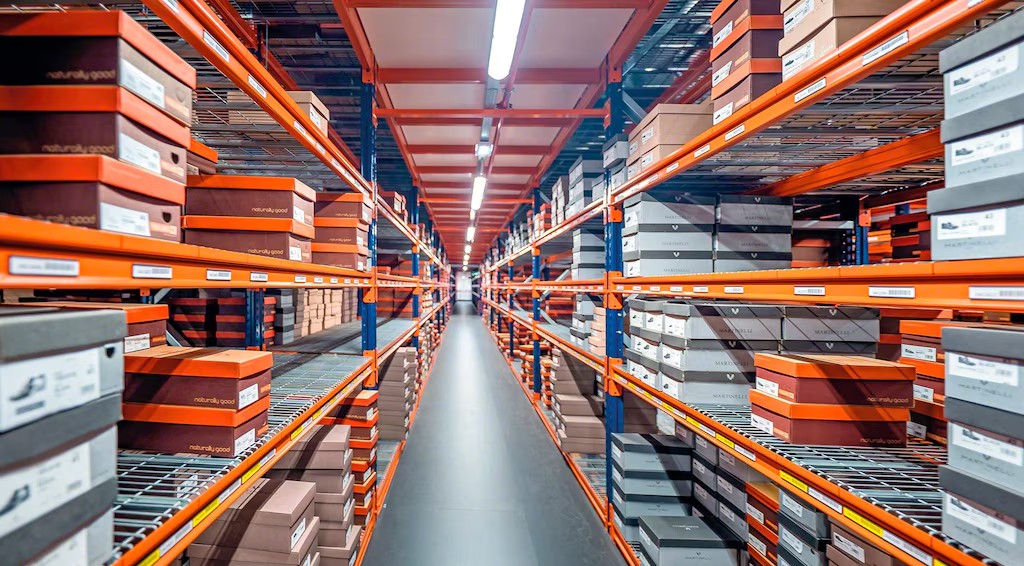
Standard pallet racking handles most warehouse stock comfortably. It stops being appropriate somewhere around the point where a single pallet weighs more than a small car, and the change is not simply a matter of ordering thicker steel. Industrial storage racks built for heavy load applications differ in section, connection design, bracing, anchoring and in what the floor underneath has to be capable of carrying.
What Counts as Heavy
There is no single threshold, but the questions change once individual unit loads move into the low tonnes: steel coils and plate, castings, machined components, moulds and dies, battery packs, granite and stone slabs, drums of liquid, and bagged raw materials stacked on reinforced pallets. Density matters as much as weight, since a compact two-tonne load concentrates its mass over a small area of the beam rather than spreading it. Both figures belong in the design brief.
Where the Capacity Actually Comes From
Beam capacity is what most buyers focus on, and it is the easier half of the problem. Upright capacity is the harder half, because an upright carries the accumulated load of every level above the floor, and its capacity depends on the vertical distance between beam levels. Raising a beam by two hundred millimetres to accommodate a taller load reduces what the upright can carry, sometimes substantially. This is why moving a beam without consulting the load table is a genuinely dangerous act rather than an administrative shortcut.
Steel Section and Connection Design
Heavy duty frames use thicker gauge and deeper sections, and the connection between beam and upright is engineered rather than incidental. Boltless connectors with multiple engagement points distribute load differently from lighter clip systems, and safety locks preventing accidental beam dislodgement become more important as load increases. Ask what the beam end connector is rated for in uplift as well as in downward load, since a forklift catching a beam from beneath is the movement that unseats it.
Bracing and Stability
A tall, heavily loaded run is a structure resisting more than gravity. Frame bracing, run spacers between back-to-back frames, and floor anchoring all keep the installation stable under handling forces and accidental impact. Anchors are not a formality: baseplates must be fully seated, and the anchor type and embedment specified for the slab rather than chosen for convenience. In seismic-free conditions the governing loads are handling and impact, and those are more than sufficient to matter.
The Slab Beneath
Every load reaches the floor through a small baseplate, producing point loads that a slab designed for general warehouse use may not have been intended to carry. In older buildings and converted premises this deserves a proper check rather than an assumption. Flatness matters too, since an upright standing on an uneven surface is loaded eccentrically from the day it is installed. Suppliers of heavy duty racking systems should raise the slab question before quoting.
Deck the Levels Correctly
Heavy loads on beams alone concentrate force at two lines. Where loads are irregular, where pallets are damaged, or where non-palletised items are stored directly, decking distributes the load and prevents anything falling through. Options include steel wire mesh, which allows sprinkler penetration and is preferred where fire protection depends on it, steel panel decking for very heavy or oily loads, and timber, which is cheaper and burns. The choice interacts with fire strategy, so it is not purely a handling decision.
Handling Equipment Has to Match the Load
A rack rated for three tonnes per level is useless if the truck cannot place three tonnes at height. Lift capacity derates as the mast extends, and the figure on the data plate applies at a specified height and load centre, not at the top beam level with a deep pallet. Attachments and extended forks reduce it further. Confirm the residual capacity of your truck at the highest beam level you intend to use before finalising the layout, because discovering the limitation after installation forces either a shorter run or a taller-capacity truck, and both are expensive corrections.
Cantilever for Long and Awkward Loads
Steel bar, pipe, extrusions, sheet material and panels do not palletise, and forcing them onto beam racking is a recurring source of accidents. Cantilever racking carries them on arms projecting from a column, with capacity specified per arm and per column. Arm spacing must reflect how much the stored material deflects between supports, and the base must be sized to resist the overturning moment created by loading only one side.
Impact Protection Is Not Optional
The single largest cause of rack failure is forklift impact, and the consequences scale with the load above. Column guards at aisle-facing uprights, end-of-aisle barriers, and clear floor markings are cheap relative to what they protect. A damaged upright carrying several tonnes per level should be offloaded and assessed rather than watched, since the loss of capacity from a dent is disproportionate to how minor it looks.
Documentation and Ongoing Checks
Insist on load notice plates stating the capacity per beam level and per bay, the beam configuration those figures assume, and the design standard used. Keep the layout drawing. Brief the team that beam levels cannot be repositioned without checking the load table, and inspect regularly for impact damage, missing safety locks, loose anchors and out-of-plumb frames. Used within their rating and inspected properly, industrial storage racks built for heavy load applications will outlast the operation that installed them.