
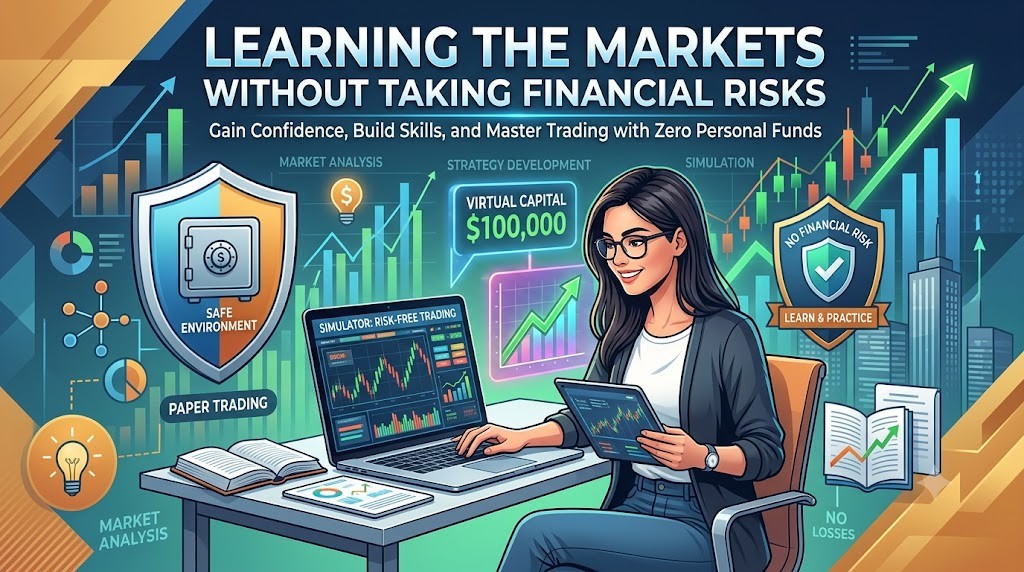
Stepping into the world of financial markets can feel both exciting and intimidating. Charts move constantly, prices react to global events, and countless strategies promise success. For someone just getting started, it is easy to feel overwhelmed by the sheer amount of information available and the fear of making costly mistakes before understanding how everything works.
Fortunately, learning how markets function does not have to involve risking real money. Modern trading technology has created opportunities for beginners to gain practical experience in realistic environments before committing any capital. This approach allows aspiring traders to develop confidence, improve decision-making, and better understand market behaviour while protecting their finances.
Why Practical Experience Matters More Than Theory
Reading books, watching educational videos, and following financial news provide an excellent foundation, but theoretical knowledge alone rarely prepares someone for live market conditions. Successful learning comes from combining education with hands-on experience that reflects real market movement.
Financial educators and industry professionals consistently emphasise that developing trading skills requires repetition. Similar to learning to drive a car or mastering a new language, understanding financial markets becomes easier when concepts are applied repeatedly in realistic situations rather than simply studied.
This is why many beginners choose to practice with a stock demo account UAE before entering live markets. A simulated trading environment allows users to place trades using virtual funds while experiencing real-time market conditions. They can test strategies, learn platform features, and understand how different assets respond to economic events without exposing themselves to financial losses.
Building Confidence Through Consistent Practice
Confidence in trading is not created by making one successful trade. Instead, it develops through repeated exposure to different market scenarios and thoughtful analysis of each decision. Practising regularly helps transform uncertainty into familiarity.
Market conditions constantly change. Some days experience strong momentum, while others remain relatively quiet. Learning how different conditions affect trading decisions helps individuals become more adaptable and less likely to react emotionally when markets become volatile.
A practice environment also encourages experimentation. Traders can evaluate various approaches, compare technical indicators, adjust position sizes, and observe how different strategies perform over time. Since no real money is involved, mistakes become valuable learning experiences rather than expensive setbacks.
Developing Strong Risk Management Habits
One of the biggest misconceptions among beginners is that successful trading depends primarily on identifying winning opportunities. In reality, experienced professionals often emphasise that managing risk is equally important, if not more so.
Financial institutions, educational organisations, and experienced market participants commonly stress the importance of limiting potential losses. Effective risk management includes setting appropriate stop-loss levels, controlling position sizes, and avoiding emotional decision-making during periods of market uncertainty.
Practising these habits in a simulated environment allows new traders to establish disciplined routines before real money enters the equation. They can learn how different levels of risk affect overall portfolio performance while recognising the importance of consistency over short-term gains. Building these habits early often creates a stronger foundation for future decision-making.
Learning How Markets React to Global Events
Financial markets rarely move without reason. Economic reports, corporate earnings announcements, interest rate decisions, geopolitical developments, and investor sentiment all influence price movements across different asset classes.
Following these events while observing corresponding market reactions helps beginners connect theory with reality. Instead of simply reading headlines, they begin recognising why prices move, how volatility changes, and which sectors respond differently under varying economic conditions.
Over time, this process develops broader market awareness. Rather than focusing only on individual trades, learners gain a deeper understanding of market cycles, investor psychology, and the relationship between economic news and financial performance. This broader perspective supports more informed decisions in the future.
Turning Practice Into Long-Term Growth
Using a simulated trading environment should not be viewed as a shortcut to immediate success. Instead, it serves as a structured learning process that encourages gradual improvement. The most effective learners regularly review their performance, identify recurring mistakes, and adjust their strategies based on evidence rather than emotion.
Keeping a trading journal can significantly enhance this learning process. Recording trade entries, exits, reasoning, emotions, and outcomes creates valuable insights that may otherwise go unnoticed. Reviewing this information helps traders recognise behavioural patterns and refine their decision-making over time.
Eventually, the transition from simulated to live trading becomes less intimidating because essential skills have already been practised repeatedly. While real markets naturally introduce emotional factors that cannot be fully replicated, learners who have invested time in disciplined practice often approach live trading with greater confidence, realistic expectations, and stronger preparation.
Conclusion
Learning the financial markets does not require immediate financial commitment. In fact, taking time to build knowledge, practice consistently, and develop disciplined habits often creates a much stronger starting point than rushing into live trading. Every successful journey begins with understanding how markets behave and how personal decisions influence long-term outcomes.
By combining education with practical experience in a risk-free environment, aspiring traders can strengthen their analytical skills, improve risk management, and build confidence before investing real capital. Patience, consistent practice, and a willingness to learn from mistakes remain some of the most valuable assets anyone can develop while preparing for long-term participation in today’s financial markets.